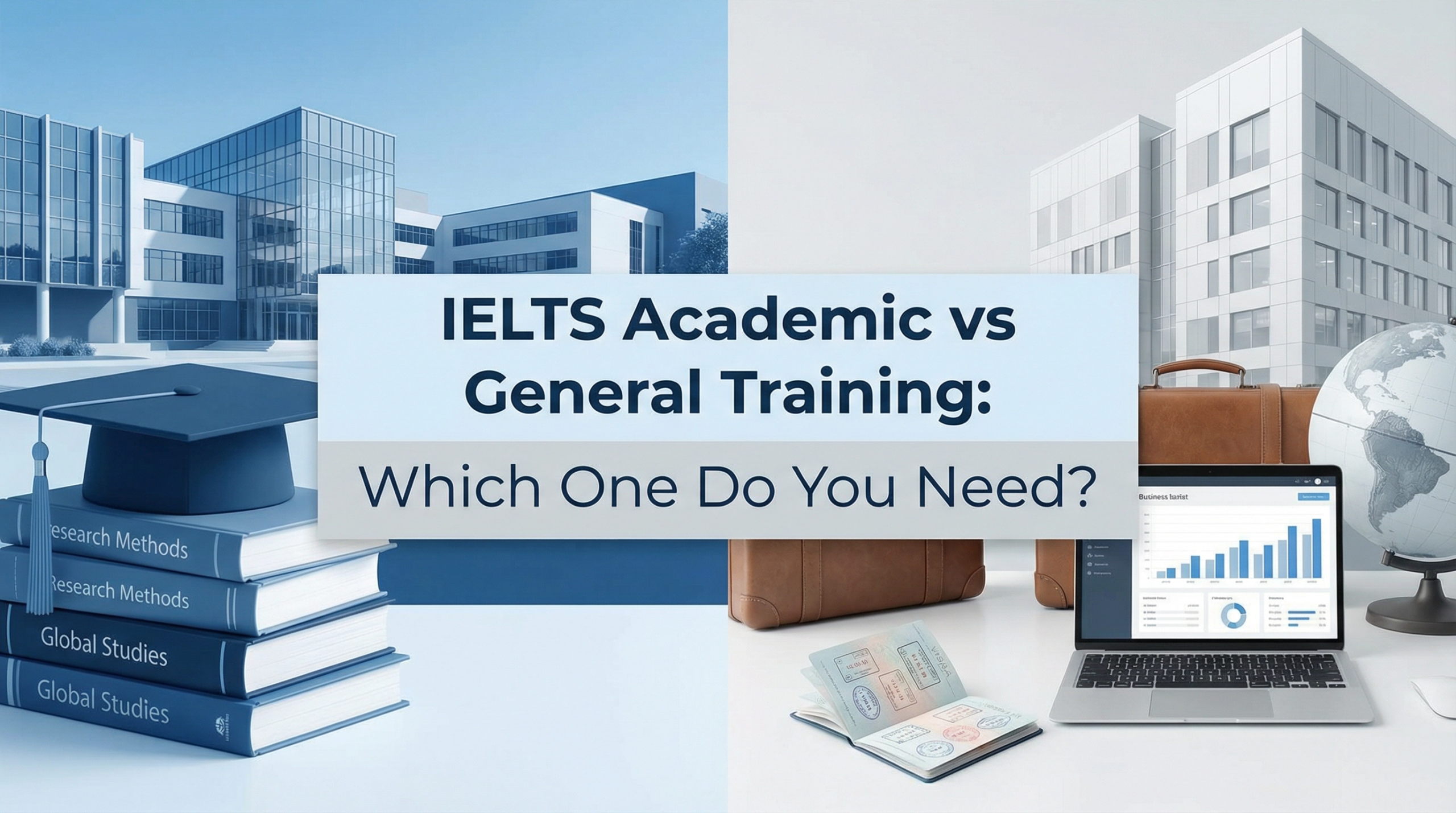
Confused about IELTS Academic vs General Training? Learn the key differences, who needs each test, and how to choose the right one for study, work, or migration. Avoid costly mistakes before you register.
Table of Contents
Key Takeaways
- IELTS has two versions, Academic for study and professional use, and General Training for migration and work
- The main difference is content, Academic focuses on formal and analytical English while General focuses on everyday communication
- Your goal determines your test, university and certification require Academic while immigration and jobs require General
- Choosing the wrong test can delay your plans since you cannot switch after booking and must pay again
- Always confirm requirements for your country or program before registering to avoid costly mistakes
If you are planning to study, work, or migrate abroad, choosing the right version of IELTS is one of the most important early decisions you will make. It may seem like a small step, but it can have a major impact on your entire application process.
Many candidates rush into booking a test without fully understanding the difference between IELTS Academic and IELTS General Training. This simple mistake can lead to delays, extra costs, or even rejection from a school or visa program. What makes it more challenging is that both tests appear very similar at first glance. They share the same format, scoring system, and sections, which often leads people to assume they are interchangeable.
They are not.
Each version is designed for a specific purpose. IELTS Academic is typically required for university admission and professional registration, while IELTS General Training is used for migration and work-related applications. Choosing the wrong one can set you back weeks or even months.
For example, someone applying for immigration might take IELTS Academic by mistake, only to later discover that their visa requires General Training. At that point, they have no choice but to register again and retake the test. On the other hand, a student applying to a university with a General Training result may have their application rejected outright.
This is where proper guidance becomes essential. With support from BIVENT, candidates can avoid these costly mistakes and make the right decision from the start. BIVENT provides expert advice on test selection, registration, and preparation, helping candidates move forward with clarity and confidence.
Whether you are preparing in Abuja, Lagos, Port Harcourt, or across states like Edo, Imo, Ogun, Delta, and Enugu, you can access reliable support tailored to your goals.
This guide breaks everything down in a clear and practical way. You will understand the real differences between both tests, see examples of what to expect, and learn exactly which one fits your situation. By the end, you will be able to make a confident decision and avoid the common mistakes that hold many candidates back.
What Is IELTS?
The IELTS is one of the most widely recognized English language proficiency tests in the world. It is used to assess how well you can communicate in English in real-life situations, whether in an academic setting, a workplace, or everyday life abroad.
Thousands of organizations accept IELTS, including universities, employers, and immigration authorities in countries like the UK, Canada, and Australia. For many people, it is a required step before they can study, work, or relocate internationally.
The test evaluates your ability across four core language skills:
- Listening: You will listen to conversations and recordings, then answer questions to show how well you understand spoken English in different contexts.
- Reading: You will read passages and answer questions that test comprehension, interpretation, and attention to detail.
- Writing: You will complete two tasks that assess how clearly and effectively you can express ideas in written English.
- Speaking: You will have a face to face interview with an examiner to evaluate your spoken English, fluency, and confidence.
IELTS uses a band score system from 0 to 9, where each section receives a score, and an overall average is calculated. This makes it easy for institutions and authorities to assess your level.
There are two main types of IELTS, and this is where many people get confused:
- IELTS Academic: Designed for people applying to universities or professional bodies. It focuses on formal and academic English.
- IELTS General Training: Designed for people migrating or seeking work opportunities. It focuses on practical, everyday communication.
Both versions share the same test format for Listening and Speaking. The key differences are in the Reading and Writing sections, where the content changes based on the purpose of the test.
Understanding this distinction is critical, because choosing the right type is not about difficulty, it is about matching the test to your goal.
IELTS Academic vs General Training: Key Differences
Quick Answer:
IELTS Academic is for people applying to universities or professional bodies, while IELTS General Training is for those migrating or working abroad. Academic focuses on formal and academic English, while General focuses on everyday communication.
Key Differences:
- Academic is for study and professional registration
- General is for migration and work
- Academic uses complex texts and data interpretation
- General uses real-life situations and practical writing
IELTS Academic Module Explained
Who Should Take IELTS Academic
- Students applying to universities abroad
- People seeking professional certification such as healthcare or engineering
- Postgraduate applicants
What the Academic Test Looks Like
- Reading academic articles and journals
- Writing reports based on charts or graphs
- Writing formal essays
Example:
You may be asked to describe a graph showing population growth or compare data trends.
When It Is Required
- University admission in the UK, Canada, Australia
- Professional licensing bodies
- Scholarship applications
IELTS General Training Module Explained
Who Should Take IELTS General Training
- People applying for immigration
- Job seekers moving abroad
- Work visa applicants
What the General Test Looks Like
- Reading advertisements, emails, and notices
- Writing letters
- Practical communication tasks
Example:
You may be asked to write a letter to your landlord about a repair issue or a complaint.
When It Is Required
- Immigration programs
- Work permits
- Some training or secondary education programs
IELTS Academic vs General Training: Side by Side Comparison
| Feature | IELTS Academic | IELTS General Training |
| Purpose | Study and professional use | Migration and work |
| Reading | Academic texts | Everyday materials |
| Writing | Reports and essays | Letters and essays |
| Focus | Analytical and formal | Practical and real-life |
| Use Case | University admission | Immigration and jobs |
Is IELTS Academic Harder Than General Training?
This is one of the most common questions, and the honest answer is that the two tests are different rather than one being strictly harder than the other. The difficulty depends more on your background, strengths, and what kind of English you are used to.
The biggest difference shows up in the Reading and Writing sections, where each test is designed for a specific purpose.
Reading: Academic vs General
- IELTS Academic Reading includes longer, more complex texts taken from books, journals, and research articles. You may need to understand arguments, identify opinions, and interpret data.
- IELTS General Reading uses everyday materials like advertisements, emails, notices, and workplace documents. The language is simpler, but you still need to read carefully to avoid mistakes.
Writing: Academic vs General
- IELTS Academic Writing requires you to:
- Describe visual data such as graphs or charts
- Write a structured essay with clear arguments and analysis
- IELTS General Writing requires you to:
- Write a letter, which could be formal or informal
- Write an essay, usually based on everyday topics
Which One Feels Harder?
- If you are used to school, university, or academic reading, Academic may feel natural
- If you are more comfortable with everyday English and real-life communication, General may feel easier
Many test takers find Academic more challenging because:
- It requires deeper analysis
- The vocabulary is more advanced
- The writing is more structured and formal
However, this does not mean General is easy. It still tests:
- Accuracy
- Clarity
- Proper tone and grammar
Which IELTS Test Is Required by Country?
Canada
- Immigration programs usually require IELTS General Training
- Academic is used for university admission
United Kingdom
- Academic for university applications
- General or UKVI version for visas depending on the route
Australia
- General for migration
- Academic for higher education
Tip: Always confirm with the specific program or institution. Requirements can vary.
IELTS Requirements for Nigerian Test Takers
If you are applying from Nigeria, your choice usually depends on your goal:
- Canada immigration → General Training
- UK study → Academic
- Work abroad → General Training
Many Nigerian applicants make the mistake of choosing Academic when applying for immigration. This often leads to retaking the test and paying again.
Which IELTS Test Should You Choose?
Use this simple decision guide:
- If you want to study at a university → choose Academic
- If you want to migrate or work → choose General Training
Quick decision flow:
- University or professional certification → Academic
- Visa, job, or relocation → General
Common mistakes:
- Choosing based on perceived difficulty instead of requirements
- Not checking official requirements before booking
- Assuming one test works for all purposes
Can You Switch Between IELTS Academic and General Training?
Short answer: no, you cannot switch your test type after registering for the IELTS.
Once your booking is confirmed, your test module is locked in. This applies whether you register online or through a test center. If you realize later that you selected the wrong version, there is no direct way to convert or upgrade your booking.
What Happens If You Choose the Wrong Test?
If you pick the wrong module, your only option is to:
- Book a new exam with the correct test type
- Pay the full registration fee again
- Wait for a new test date, which could delay your plans
In some cases, you may be able to cancel or reschedule your test, but:
- Refunds are usually partial
- Deadlines apply
- Policies vary by test center
So even with a cancellation, you may still lose money and time.
Real Impact of Choosing the Wrong IELTS
This mistake is more common than you might think, and the consequences can be serious:
- Missed application deadlines for schools or visa programs
- Extra costs from rebooking the test
- Delayed travel or admission timelines
- Unnecessary stress and preparation time
For example, someone applying for Canadian immigration who takes IELTS Academic will not be able to use that result. They will need to start over with IELTS General Training.
How to Avoid This Mistake
Before you register, take a few minutes to confirm your requirement:
- Check your university admission page if you are applying to study
- Review the official immigration website for your destination country
- Ask your consultant, employer, or institution if you are unsure
Do not rely on assumptions or what others are doing. Requirements can differ depending on your exact goal..
FAQs
Can I use IELTS General for university?
In most cases, no. Universities typically require the Academic version of the IELTS because it reflects the kind of English used in lectures, research, and academic writing.
However, there are a few exceptions:
- Some colleges or foundation programs may accept General Training
- Certain vocational or diploma courses may be more flexible
That said, you should always check directly with your institution. Do not assume General will be accepted.
Which IELTS is required for Canada immigration?
For most Canadian immigration pathways, including Express Entry, IELTS General Training is required.
Academic IELTS is not accepted for immigration purposes. It is only valid for:
- University applications
- Professional licensing in some fields
If your goal is permanent residency, make sure you choose General Training from the start.
Can I use IELTS Academic for migration?
In most cases, no. Immigration programs in countries like Canada, the UK, and Australia usually require General Training because it reflects everyday communication skills.
There are rare exceptions:
- Some UK visa categories may accept Academic under specific conditions
- Certain professional migration pathways may require Academic
Always confirm with the official immigration authority before booking your test.
Do both IELTS tests use the same scoring system?
Yes, both Academic and General Training use the same band score system from 0 to 9.
- Each section (Listening, Reading, Writing, Speaking) is scored individually
- Your overall score is the average of all four sections
Even though the content differs, the scoring standard is consistent across both test types.
How long is IELTS valid?
Your IELTS result is valid for two years from the test date.
After that:
- Most universities and immigration bodies will no longer accept it
- You will need to retake the test if your score expires
Because of this, timing matters. Try to take IELTS close to your application period.
Which IELTS is better for jobs?
For employment and work visas, IELTS General Training is usually the better choice because it focuses on practical, everyday communication.
Employers and immigration authorities prefer it because it reflects:
- Workplace communication
- Real-life interactions
- Functional English skills
However, some highly skilled or regulated professions may still require Academic IELTS, especially if licensing is involved.
Can I take both IELTS Academic and General Training?
Yes, you can take both if needed. Some people do this when:
- They are applying for both study and migration
- Their plans change after taking one test
Just keep in mind that each test requires a separate booking and fee.
What happens if I fail IELTS?
IELTS does not have a pass or fail system. Instead, you receive a band score.
If your score is lower than required:
- You can retake the test as many times as you want
- You can improve specific skills before trying again
The key is to understand the score requirement for your goal and prepare accordingly.
Final Verdict
There is no better test. There is only the right test for your goal.
- Choose IELTS Academic if you are applying for higher education or professional certification
- Choose IELTS General Training if you are migrating or looking for work opportunities
Making the right choice the first time saves you money, time, and unnecessary stress.
Next Steps
Before you register:
- Confirm your exact requirement with your school, employer, or immigration program
- Double check the correct test type
- Start preparing early to give yourself enough time to improve
Important:
Do not book your IELTS until you are completely sure which version you need. Taking the wrong test means starting over.
Get It Right with Expert Guidance
Choosing the correct test is simple when you have the right support. With guidance from BIVENT, you can avoid costly mistakes and move forward with confidence.
Since its incorporation in 2019, BIVENT has built a strong reputation for helping students make informed decisions about international exams and study abroad pathways. Headquartered in Abuja, the organization provides trusted support across IELTS preparation, university placement, and travel consulting.
With thousands of successful IELTS candidates and recognition as a top agent under the British Council Nigeria IELTS Partnership Programme, BIVENT offers the experience and credibility you need at this critical stage.
If you are unsure which IELTS test is right for you, getting expert advice now can save you weeks or even months later.
Make the right choice from the start. Get the right guidance. Move forward with confidence.
