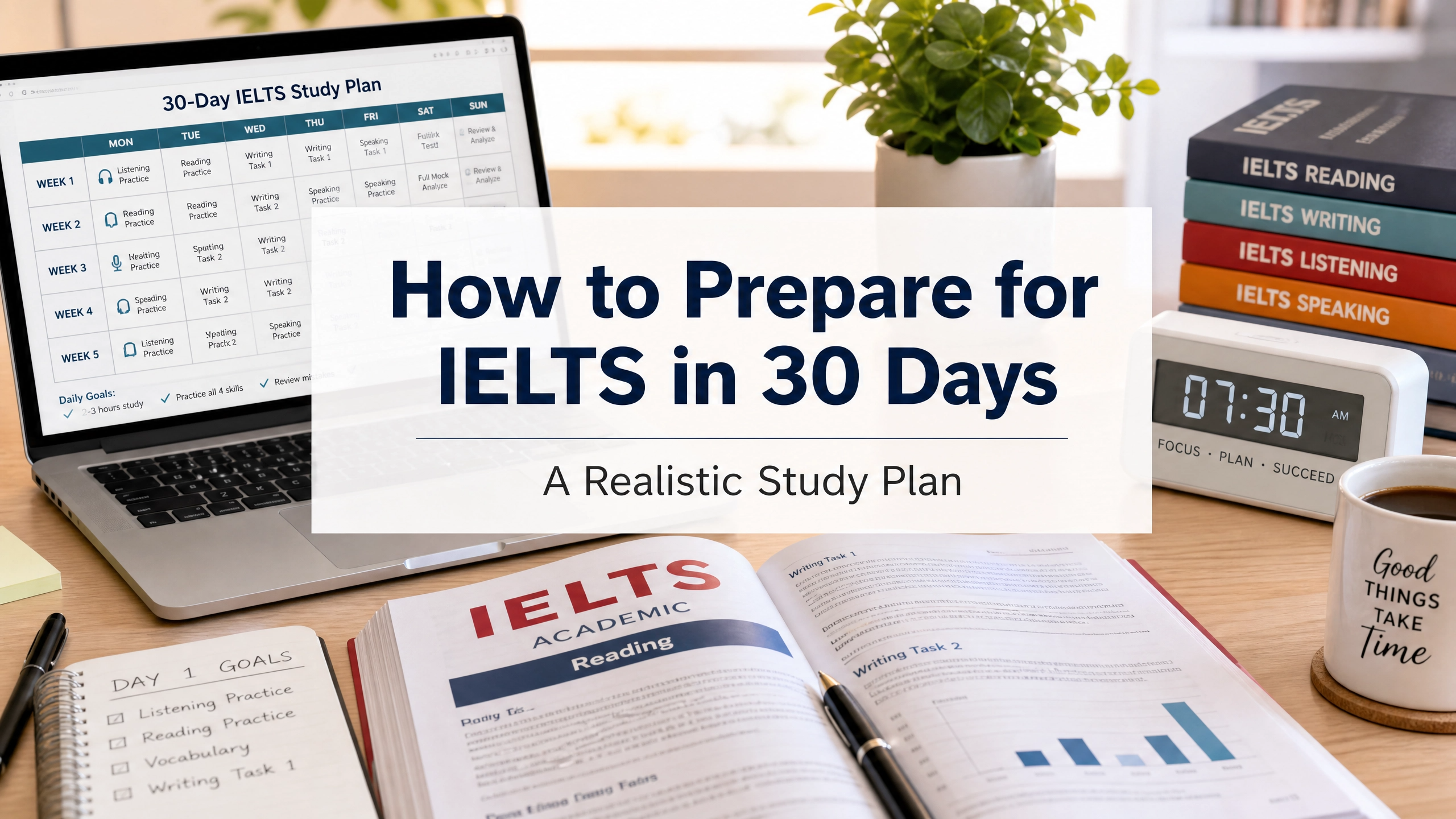
Learn how to prepare for IELTS in 30 days with a realistic day-by-day study plan, expert tips, mock test strategies, and proven techniques to improve your IELTS band score. BIVENT helps candidates with IELTS preparation and registration support.
Key Takeaways
- A structured IELTS 30-day study plan can help candidates improve their Listening, Reading, Writing, and Speaking skills effectively within one month.
- Consistency matters more than studying for extremely long hours. Daily focused practice produces better results than irregular study sessions.
- Mock tests, timed practice, and mistake reviews are essential for improving speed, confidence, and exam performance.
- IELTS Writing and Speaking often require the most improvement, so candidates should dedicate extra time to grammar, vocabulary, fluency, and essay structure.
- Realistic goals, quality study materials, and steady preparation can help many candidates improve their IELTS band score significantly in 30 days.
Preparing for IELTS in 30 days may sound ambitious, but it is achievable for many candidates. The key is not studying longer hours but studying strategically. A focused study plan allows you to improve your Listening, Reading, Writing, and Speaking skills while becoming familiar with the exam format and timing requirements.
Your results will depend on your current English level, target band score, consistency, and the quality of your study materials. Many candidates improve by half to one full band within 30 days when they follow a structured preparation schedule.
At BIVENT, candidates receive preparation guidance, registration support, and access to practical IELTS resources designed to help them approach the exam with confidence.
Table of Contents
Can You Really Prepare for IELTS in 30 Days?
Yes. Many candidates successfully improve their IELTS performance within 30 days, particularly those who already have a basic to intermediate level of English. While one month may not be enough to achieve dramatic score increases, it can provide enough time to strengthen weak areas, improve exam techniques, and build confidence across all four sections of the test.
Your results will depend on factors such as your current English proficiency, target band score, study consistency, and the quality of your preparation. Candidates who follow a structured study plan, practice under timed conditions, and regularly review their mistakes often see the greatest improvement.
What Band Score Can You Improve to in 30 Days?
| Current Level | Realistic Improvement |
| Band 5 | Band 6 |
| Band 6 | Band 6.5 to 7 |
| Band 7 | Band 7.5+ |
While significant score increases typically require longer preparation periods, many candidates achieve noticeable improvements within a month through focused practice and consistent study.
The key is to set realistic expectations and focus on steady progress rather than overnight results. Improving your Listening, Reading, Writing, and Speaking skills a little each day can make a meaningful difference in both your score and confidence on exam day.
Before You Start Your IELTS Preparation
Before creating your IELTS study plan, take time to assess your current level and prepare the right resources. Understanding your strengths, weaknesses, and target score will help you focus your efforts and make the most of your 30-day preparation period.
Take a Diagnostic Test
Start by taking a full IELTS practice test under timed conditions. A diagnostic test helps you estimate your current band score, identify your strongest and weakest areas, and create a more focused study strategy.
Many candidates discover unexpected challenges during their first mock test. Some struggle with time management despite having strong English skills, while others perform well in Listening and Reading but need improvement in Writing or Speaking. Identifying these gaps early allows you to prioritize the areas that need the most attention.
Gather the Right IELTS Study Materials
Using reliable study materials can significantly improve your preparation. Rather than relying on countless online resources, focus on a small number of trusted IELTS preparation tools.
Recommended resources include:
- Cambridge IELTS books
- British Council IELTS resources
- IDP IELTS preparation materials
- IELTS Liz
- E2 IELTS
- IELTS Advantage
- BBC Learning English
- IELTS Prep App
- Quizlet vocabulary flashcards
At BIVENT, candidates are encouraged to follow a structured preparation approach using trusted, exam-focused resources that align with their target band score and study goals.
How Many Hours Should You Study Daily?
The amount of time you study depends on your schedule, current English level, and target score. While longer study sessions can be helpful, consistency is often more important than total study hours.
Full-Time Students
Study for 4 to 5 hours daily, allowing enough time for practice, vocabulary building, mistake reviews, and mock tests.
Working Professionals
Aim for 2 to 3 focused hours daily. Short, consistent study sessions before or after work can produce excellent results.
Busy Candidates
Study for around 90 minutes each weekday and dedicate additional time on weekends for mock tests, essay writing, and speaking practice.
The goal is not to study as much as possible. The goal is to practice consistently, review your mistakes, and make steady progress every day.
Understanding the IELTS Exam Format
Before starting your preparation, it is important to understand how the IELTS exam is structured. Familiarity with the format, timing, and question types can help you avoid common mistakes and approach the exam with greater confidence.
The IELTS exam consists of four sections: Listening, Reading, Writing, and Speaking.
IELTS Listening
Duration: 30 minutes
The Listening section contains four recordings and 40 questions based on conversations, discussions, and academic presentations. Candidates are assessed on their ability to understand spoken English, identify key information, and follow different accents.
IELTS Reading
Duration: 60 minutes
The Reading section includes 40 questions based on several passages. It tests reading comprehension, information retrieval, vocabulary understanding, and the ability to identify key ideas and arguments.
IELTS Writing
Duration: 60 minutes
The Writing section consists of two tasks.
For IELTS Academic, Task 1 requires candidates to describe visual information such as charts, graphs, or tables, while Task 2 involves writing an essay.
For IELTS General Training, Task 1 involves writing a letter, while Task 2 remains an essay-writing task.
Candidates are assessed on task achievement, organization, vocabulary, grammar, and coherence.
IELTS Speaking
Duration: 11 to 14 minutes
The Speaking test is a face-to-face interview with an examiner. It evaluates fluency, pronunciation, vocabulary, grammatical accuracy, and the ability to communicate ideas clearly and confidently.
IELTS Academic vs IELTS General Training
Choosing the correct IELTS version is essential before registering for the exam.
IELTS Academic is designed for university admissions, postgraduate studies, and professional licensing.
IELTS General Training is intended for immigration, work opportunities, vocational training, and secondary education.
Always confirm which IELTS version is required by your university, employer, professional body, or immigration program before booking your test.
The Complete IELTS 30-Day Study Plan
This four-week IELTS study plan is designed to help you improve all four test sections while building confidence and exam readiness through consistent practice.
Week 1: Build Your Foundation
Focus on understanding the IELTS format, scoring criteria, and common question types. Complete a full diagnostic test to identify your strengths and weaknesses and start a vocabulary notebook.
Practice Listening using IELTS recordings, TED Talks, and BBC podcasts. Build vocabulary around common IELTS topics such as education, technology, health, travel, and the environment.
For Reading, focus on skimming, scanning, keyword identification, and question analysis. Complete at least one timed Reading practice and review your mistakes carefully.
By the end of the week, you should understand the exam structure and have a clear picture of the areas that need improvement.
Week 2: Focus on Writing and Speaking
Dedicate this week to improving your Writing and Speaking skills.
Learn the structure of IELTS Writing Task 1 and practice describing charts, tables, and graphs clearly and accurately. For Task 2, focus on common essay types such as opinion, discussion, problem-solution, and advantage-disadvantage essays.
Strengthen your grammar by reviewing sentence structure, verb tenses, subject-verb agreement, and articles.
Practice speaking daily by answering common interview questions, discussing IELTS topics, and responding to cue cards. Record yourself to identify areas for improvement in fluency, pronunciation, vocabulary, and grammar.
Week 3: Intensive Practice and Mock Tests
Begin applying your skills under exam conditions.
Complete timed Listening and Reading exercises, continue building academic vocabulary, and review previous Writing and Speaking practice to identify recurring mistakes.
Focus on improving speed, accuracy, and time management across all sections.
At the end of the week, complete a full IELTS mock test under realistic exam conditions.
Week 4: Final Revision and Exam Readiness
Use the final week to strengthen weak areas and reinforce what you have already learned.
Review grammar notes, vocabulary lists, essay structures, and speaking frameworks. Continue practicing all four sections, paying extra attention to areas where you score lowest.
Complete a final full-length mock test and treat it exactly like the real exam.
In the days leading up to your exam, avoid cramming new material. Focus on reviewing mistakes, maintaining confidence, getting enough rest, and preparing mentally for test day.
IELTS Study Plan for Busy Students and Working Professionals
Many IELTS candidates are balancing exam preparation with work, university studies, family responsibilities, or other commitments. While finding several hours each day may not be realistic, meaningful progress is still possible with a structured and consistent routine.
The key is to focus on quality rather than quantity. Even short daily study sessions can produce strong results when used effectively and combined with regular practice tests.
Weekday IELTS Routine
A simple weekday study schedule can help maintain steady progress without becoming overwhelming.
- 30 minutes of listening practice using IELTS recordings, podcasts, or English news content
- 30 minutes of reading practice focused on comprehension, skimming, and scanning techniques
- 30 minutes of writing or Speaking practice, alternating between the two throughout the week
This approach allows you to work on all four IELTS skills while fitting preparation into a busy schedule.
Weekend IELTS Routine
Weekends provide an opportunity for more focused preparation and exam simulation.
Use this time to:
- Complete a full IELTS mock test
- Review writing tasks and essay corrections
- Practice speaking with a study partner or recording exercises
- Revise vocabulary, grammar notes, and common question types
- Analyze mistakes from previous practice sessions
Consistent effort over several weeks often produces better results than occasional long study sessions. Even candidates with limited study time can make significant progress by following a structured routine and staying disciplined throughout their preparation.
IELTS Study Plan for Busy Students and Working Professionals
Preparing for IELTS while managing work, studies, or family responsibilities can be challenging, but consistent practice is often more important than long study sessions. Even with limited time, a structured routine can help you make steady progress.
Weekday IELTS Routine
Set aside approximately 90 minutes each day:
- 30 minutes of listening practice using IELTS recordings, podcasts, or English news content
- 30 minutes of reading practice focused on comprehension, skimming, and scanning
- 30 minutes of writing or Speaking practice, alternating between the two throughout the week
Weekend IELTS Routine
Use weekends for more focused preparation and exam simulation:
- Complete a full IELTS mock test
- Review Writing tasks and corrections
- Practice Speaking exercises
- Revise vocabulary and grammar notes
- Analyze mistakes from previous practice sessions
Consistent daily practice, combined with regular mock tests and mistake reviews, can help busy candidates achieve meaningful improvement even with limited study time.
Common IELTS Preparation Mistakes
Many candidates spend weeks preparing for IELTS but fail to achieve their target score because of a few avoidable mistakes. Identifying these habits early can help you study more effectively and make better use of your preparation time.
Studying Without a Plan
Preparing without a structured study schedule often leads to inconsistent progress. A clear study plan helps you balance all four IELTS sections while focusing on your weakest areas.
Watching Too Many Strategy Videos
IELTS tips and strategy videos can be useful, but they should support your preparation rather than replace it. Real improvement comes from active practice, mock tests, and reviewing mistakes.
Avoiding Timed Practice
IELTS is a timed exam, and many candidates underestimate the importance of practicing under exam conditions. Regular timed exercises help improve speed, accuracy, and confidence.
Memorizing Essays and Speaking Answers
Memorized responses can sound unnatural and are often easy for examiners to identify. Focus on understanding essay structures, developing ideas, and communicating naturally instead.
Ignoring Mistake Reviews
Completing practice tests is only part of the preparation process. Reviewing mistakes helps you identify recurring weaknesses and avoid repeating them in future practice sessions and on exam day.
Neglecting Speaking Practice
Many candidates focus heavily on Reading and Writing while overlooking speaking. Regular speaking practice improves fluency, pronunciation, confidence, and overall performance during the interview.
FAQs
Is One Month Enough to Prepare for IELTS?
Yes. Many candidates improve their IELTS performance within 30 days through focused study, regular practice, and mock tests. While major score increases may require more time, one month is often enough to strengthen weak areas and build confidence before the exam.
Can I Prepare for IELTS at Home?
Absolutely. With official IELTS materials, online resources, and a structured study plan, many candidates successfully prepare from home. The key is maintaining consistency and practicing all four sections of the exam regularly.
How Many Hours Should I Study Daily for IELTS?
Most candidates benefit from studying between two and five hours daily, depending on their current English level and target score. However, consistent daily practice is usually more effective than occasional long study sessions.
Can I Get Band 7 Without Coaching?
Yes. Many candidates achieve Band 7 through self-study by using reliable resources, taking mock tests, reviewing mistakes, and following a structured preparation plan. Coaching can help, but it is not essential for success.
Which IELTS Section Is the Most Difficult?
Writing is often considered the most challenging section because it requires strong grammar, vocabulary, organization, and time management. However, the most difficult section varies by candidate and depends on individual strengths and weaknesses.
Final Thoughts
Preparing for IELTS in 30 days is challenging, but it is achievable with a realistic study plan, consistent effort, and the right preparation resources. Success comes from understanding the exam format, practicing under timed conditions, reviewing mistakes, and steadily improving your skills across Listening, Reading, Writing, and Speaking.
Rather than focusing solely on your target band score, focus on building strong study habits and making progress each day. Small improvements accumulate quickly, and by exam day, you may be surprised by how much your confidence and performance have improved.
If you need support with IELTS registration, preparation guidance, mock tests, or study abroad opportunities, BIVENT can help. As a member of the British Council Nigeria IELTS Partnership Programme, BIVENT has helped thousands of students and professionals prepare for international education, career advancement, and migration opportunities.
Start your preparation today, stay consistent, and give yourself the best possible chance of achieving your target IELTS band score.
